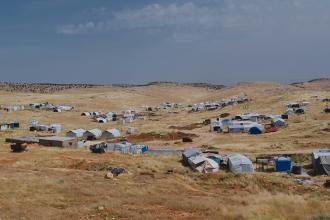
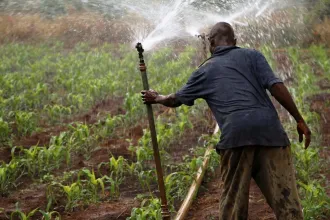
Trailblazing pledges for climate action on energy, recycling and reforestation in situations of displacement unveiled at workshop in Kampala.
Driving Climate Action Partnerships in Displacement, international workshop focused on innovative initiatives tackling climate challenges for displaced and host communities, informing pledges ahead of the Global Refugee Forum.
UNEP Copenhagen Climate Centre co-hosted a hybrid international workshop in Kampala, Uganda, alongside Last Mile Climate on the 8 November 2023.
The all-day session was opened by Hon. Beatrice Atim Anywar, Minister of State for Environment for Uganda and attended by more than 150 people; half in-person and half virtually.
The workshop highlighted trailblazing initiatives on transitioning households to solar e-cooking, transforming waste into green jobs, and reforestation projects through innovative financing.
Climate action at the last mile: Three multistakeholder pledges
Keynote speaker Jaime Bourbon de Parme, the Climate Envoy of the Netherlands, kickstarted discussions that segued into three interactive sessions. These working sessions discussed specific opportunities and priority actions for the three environmentally-focused initiatives being developed ahead of December’s Global Refugee Forum (GRF) under the Climate Action at the Last Mile project, in partnership with the Ikea Foundation:
- The SOLCO initiative is the displacement-inclusion project under the newly formed Global Electric Cooking Coalition (GeCCo). SOLCO aims to transition at least 250,000 households in refugee hosting districts to solar e-cooking by mobilising 100 million USD in various forms of capital investment by 2027, by building local capacities and supply chains as well as overcoming barriers to technology uptake at the household level.
- FairRecycling explores opportunities to transform waste into wealth and scaling the great work pioneered by the Danish Refugee Council in Kenya, envisioning a future where millions of refugees have access to circular waste management. FairRecycling aims to develop self-sustainable business models that create green jobs and cleaner environments, paving the way towards a resilient economy.
- The third breakout session discussed the EcoAdapt initiative, focused on the development of nature-based solutions with innovative financing for reforestation projects in situations of displacement. EcoAdapt draws inspiration from the GCF’s decision to approve 19m USD in grant funding for ecosystem restoration in the refugee-hosting region of Kigoma in Tanzania, in a project initiated by UNHCR and developed and submitted by UNEP.
In her opening address, Hon. Beatrice Atim Anywar stated that “the Government of Uganda will be submitting its role in the SOLCO partnership as a GRF pledge, but also sees this as something that helps us deliver on our Nationally Determined Contribution to the Paris Agreement. To this end my Ministry is working in close partnership with UNEP and our National Technical Institute under the German-funded NDC Action project, to ensure alignment with related climate investment plans and proposal for Uganda.”
The Governments of Nigeria and Zambia have also expressed interest in joining the SOLCO initiative, where there is an emerging consensus on the need for global climate finance to help kick-start markets for this group of game-changing technologies for Africa.
Getting financing to where it’s needed the most
During the plenary session of the Kampala workshop Jakob Øster, Executive Director of Last Mile Climate, stated that “We often hear humanitarian organisations saying that there isn’t enough money, and that aid is insufficient … it is more a question of efficiency and crowding in private sector solutions and financing…in reality capital doesn’t automatically flow to where it is most efficient and needed… and nowhere is that more true than the green transition for people at the last mile including refugees and host communities.”
He pointed out that the combined average expenditure by humanitarian actors is well above 50,000 USD per refugee household over a 20-year period, while 94% of these households still cook with biomass.
Trailblazing pledges
On 9 November the Government of Uganda announced seven major pledges ahead of the GRF, which will be held in Geneva in December 2023, to a televised audience of high-level UN agency participants, donor country ambassadors and civil society stakeholders. The second of these Government pledges is “…to include refugees and their specific situations in the NDCs and adaptation plans to effectively reduce the carbon emissions from deforestation and to enhance access to safe, clean and affordable energy in refugee hosting districts by 2027.”
In her summary speech the Prime Minister of Uganda, the Right Hon. Robinah Nabbanja, highlighted the SOLCO pledge developed by UNEP Copenhagen Climate Centre and Last Mile Climate, stating that “…The pledge by UNEP and Last Mile Climate is a good example of pledge matching. We appreciate the pledge you have made, being a trailblazer and an example for others to follow.”