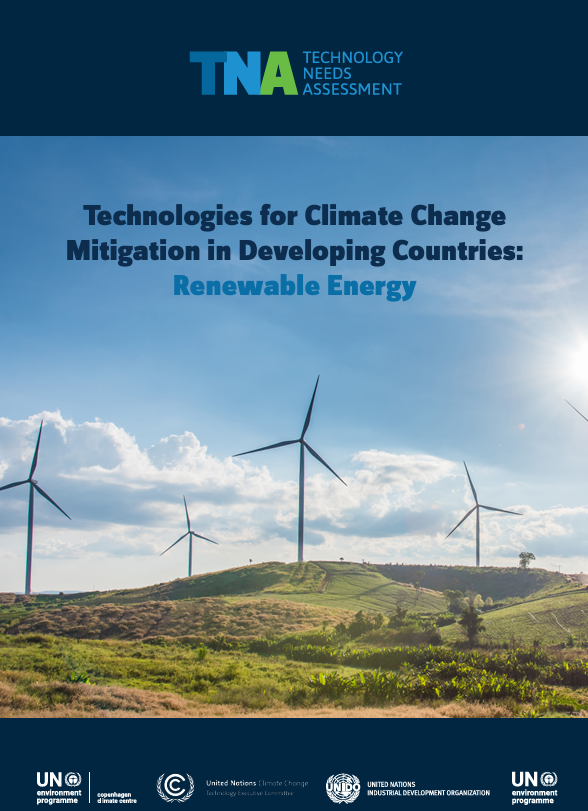
A practical new guidebook helps countries advance renewable energy through the Technology Needs Assessment (TNA) process. Designed to support just, inclusive energy transitions, the guidebook offers hands-on guidance for identifying and implementing renewable energy solutions tailored to national contexts.
The energy sector is the largest contributor to global greenhouse gas emissions. Accelerating the deployment and scaling up of zero- and low-emission energy technologies is therefore critical. The outcomes of the first global stocktake under the Paris Agreement have emphasized the pivotal role of renewable energy in achieving deep, rapid, and sustained reductions in greenhouse gas emissions, aligned with the temperature goal of the Paris Agreement.
Energy is the highest-priority sector for climate change mitigation in countries’ Technology Needs Assessments (TNAs). The energy transition lies at the core of mitigation targets outlined by Parties in their Nationally Determined Contributions (NDCs) and long-term low-emission development strategies. To support countries with dedicated guidance on mitigation technologies in the energy sector, the UNFCCC Technology Executive Committee (TEC) has partnered with the United Nations Industrial Development Organization (UNIDO) and the UNEP Copenhagen Climate Centre (UNEP-CCC) to develop a Guidebook on Renewable Energy Technologies for Climate Change Mitigation in Developing Countries.
Read more and download the guidebook here.
The Guidebook offers an overview of up-to-date information on a wide range of relevant renewable energy technologies that can be considered in the development of countries’ TNAs – either individually or in combination – depending on specific national circumstances and aligned with development and climate priorities. It is primarily intended for national TNA teams, which include national sectoral experts and stakeholders from government, non-governmental organizations, the private sector, and other relevant groups. However, it may also be useful to other practitioners working in the field.
For each renewable energy technology, the Guidebook reviews key considerations including economic assessments and affordability, mitigation and net zero emission potential, barriers to deployment, enhancing climate resilience of energy technologies, and just transition aspects. Just transition considerations can support community consultation, fair land compensation, and job creation through local hiring and training.
Launched at June Climate Meetings
On 16 June 2025 the guidebook was launched during the Technology Action Plans for Energy Systems Transformation event organized by UNFCCC in collaboration with the Technology Executive Committee (TEC), UNIDO and UNEP-CCC
The launch event of the Guidebook featured speakers from TNA countries presenting their experiences in developing and implementing TAPs, including Liberia and Brazil, as well as from key technical agencies such as the UNFCCC Secretariat, the TEC, the International Renewable Energy Agency (IRENA), Sustainable Energy for All (SE4ALL), and the United Nations Industrial Development Organization (UNIDO) and UNEP-CCC
The launch event highlighted integrated approaches to support implementation of energy sector TAPs, through finance, capacity-building, and fostering innovation.
Quotes
“The TNA guidebook on renewable energy with aspects of just transition is a valuable resource for developing country Parties to inform Paris-aligned energy systems transformations.” – Sophie De Coninck, Means of Implementation Director, UNFCCC Secretariat
“Through this guidebook, we aim to support countries in transforming their renewable energy ambitions into concrete technology action plans that are technically robust, investment-ready, and tailored to local contexts—ultimately contributing to a just, inclusive, and sustainable transformation of energy systems.” – Dietram Oppelt, Technology Executive Committee Chair
“As the global community moves toward a just and resilient energy transition, this guidebook arrives at a critical moment. It offers countries not only a clear roadmap for prioritising and deploying renewable energy technologies, but also a practical tool for embedding social equity, climate resilience, and local empowerment into national energy strategies. UNIDO is proud to contribute to this effort, supporting countries to turn ambition into action and energy innovation into inclusive, sustainable development.” – Eleonora Gatti, Head, Climate Technology Innovation Unit, Division of Climate Innovation and Montreal Protocol, UNIDO
“Delivering on the Paris Agreement requires bold and immediate action, and countries are increasingly demanding practical tools to accelerate renewable energy deployment. This new guidebook comes at exactly the right time—supporting national TNA teams with targeted, accessible knowledge to prioritize technologies that not only reduce emissions but also drive sustainable development. As UNEP and UNEP-CCC continue to support countries through the TNA process, this publication is a vital resource for turning technology needs into transformative, implementable action plans.” – Sara Trærup, TNA Global Project Coordinator and Head of Technology -Transitions and System Innovation, UNEP Copenhagen Climate Centre
About the Technology Needs Assessments:
Technology Needs Assessments (TNAs) are at the core of the work on technology development and transfer under the UNFCCC and the Paris Agreement and assist countries to identify and prioritize technologies needed for climate change adaptation and mitigation, and to formulate related implementation pathways.
Technology Action Plans (TAPs) produced under the TNA process, chart pathways to meet these climate goals while aligning with broader sustainable development objectives. In doing so, they contribute to a just, inclusive, and equitable transformation of energy systems.
In April 2025 the TNA process launched its fifth phase of work with 17 countries, many of whom have previously completed TNAs and TAPs and are now looking toward technology implementation through attracting sufficient investment from the private sector, donors, and other institutions. The TNA project is implemented by the United Nations Environment Programme and the UNEP Copenhagen Climate Centre on behalf of the Global Environment Facility.